Removal
The precise answer to the "kill" question is not complicated. You kill bamboo by dragging the rhizomes into the sunlight, just like you kill Bram Stoker's vampires.
The second answer is exactly the same. Digging the rhizomes out of the ground and properly disposing of them is the only way to eradicate the plant from a garden.
If it is going well, you need no advice. But if you need assistance call us and we can assist you with either expertise and/or labor.
During the Vietnam conflict, the U.S. military targeted bamboo groves with Agent Orange, found later to be a powerful carcinogen. It did not work on the bamboo groves. The native bamboo proved surprisingly resilient to these early chemical defoliants, so the military employed a specialized chemical agent called Agent Blue, an arsenic-based herbicide. It killed the top parts, but the bamboo grew back from rhizomes the very next year.
Short answer: a poison that could kill bamboo rhizomes underground has not been developed. If they do discover one, the researchers may not make it out of the laboratory fast enough.
A client tried using liquid nitrogen on the stubs after cutting down the culms. That did not work either.
Anyone willing to try a radioactive source — please let us all know if that works.
Read the full story — the history, the science, and what actually works →
This tactic requires cutting all the bamboo down to the ground and continuing to cut the hundreds of regressive shoots that will arise and push up the plastic. When the cutting is performed, the rhizomes react as their food source has been suddenly cut off. You might know what bamboo rhizomes do when threatened or denied their food source — they begin to grow aggressively and your problems intensify.
Many suggest this approach but we have never heard of it being effective.
First you have to cut all the canes down to the ground — this presents an immediate threat to the rhizome layers underground that receive their starches and sugars from photosynthesis. The best way to accomplish this is to actually feed and water the rhizomes so they sprout new culms, then cut them before they become green above the ground. This only works on smaller inaccessible rhizomes left under outdoor air conditioners, walkways, and other places you may not want to excavate.
Attempting to "starve" an entire grove like this will simply not work. The rhizomes under the grove will have years of stored energy to continue growing. You may then be tempted to try what a Home Depot advertisement suggests — poison the grove.
Neighbors often sue for damage caused by bamboo rhizomes traveling underground across property lines. There are no specific laws that relate to underground migration of plant materials. But if the advice in the next FAQ is followed you may be liable in civil court.
This is a complex question and best answered with a clear understanding of history. Please call or email us to discuss your unique situation.
Rhizomes
A rhizome is an underground portion of the plant that has numerous functions. The rhizomes produce culms that grow branches and leaves above ground. A rhizome also produces additional rhizomes or continues to grow underground. The rhizome stores energy in the form of starches and sugars that are produced in the culms, stems, and foliage above ground through photosynthesis. Rhizomes also produce roots that often grow deep into the soil to obtain moisture. The rhizome stores this water and delivers it to the culms, stems, and leaves above ground.
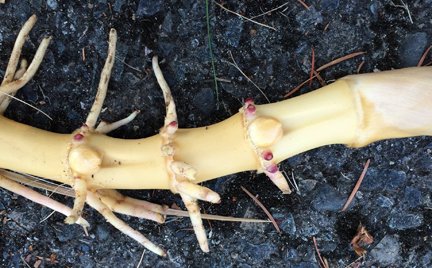
An excavated rhizome — nodes, buds, and root tendrils. Each bud is a potential new culm.
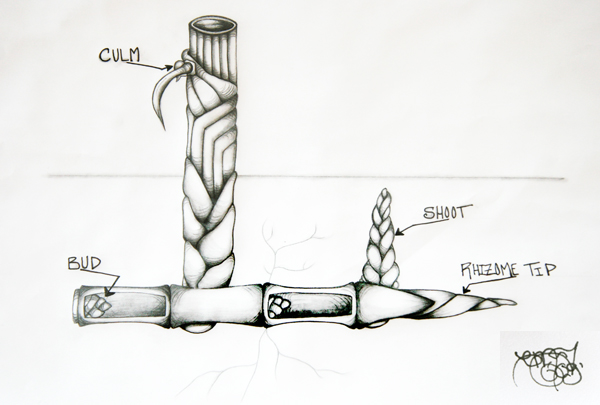
Culm, bud, shoot, rhizome tip
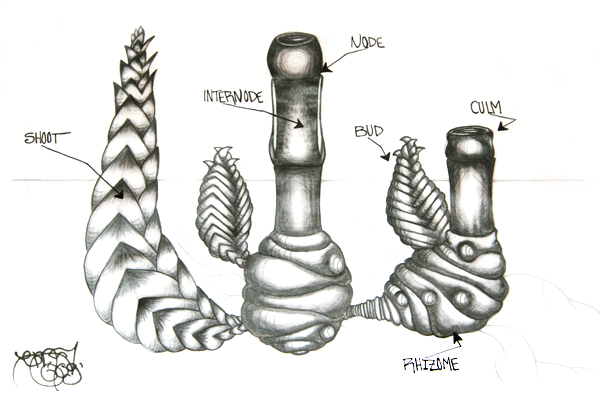
Node, internode, bud, rhizome, culm
Rhizomes, if unobstructed and unredirected by barrier, rocks, walls, or similar, grow in the upper 12 inches of soil. This encourages new shoots to penetrate a minimum depth of soil before opening up into the air and sunlight. Rhizomes also utilize oxygen for growth, survival, stress and disease resistance. When the bamboo is watered by rain or irrigation, gravity encourages the water to soak into the ground pulling oxygen into the soil.
Rhizomes have been known to travel 3 to 6 inches per day during the growing season.
Containment
Yes, for a time in new plantings. The length of time depends on many factors. The barriers, however, become filled with rhizomes and roots just like a root-bound houseplant in a container. Once this occurs, it is only a matter of time until the rhizomes find a way to escape the confinement, or the bamboo cannot thrive.
Plastic barrier should never be placed to confine an existing grove, especially if the original barrier has already failed.
Barrier maintenance is absolutely required and often results in stress and breaks in the barrier due to the sharp tools required to dig.
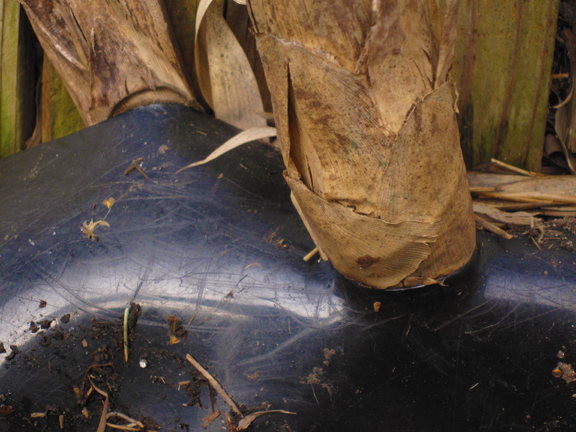
Shoot punching straight through plastic
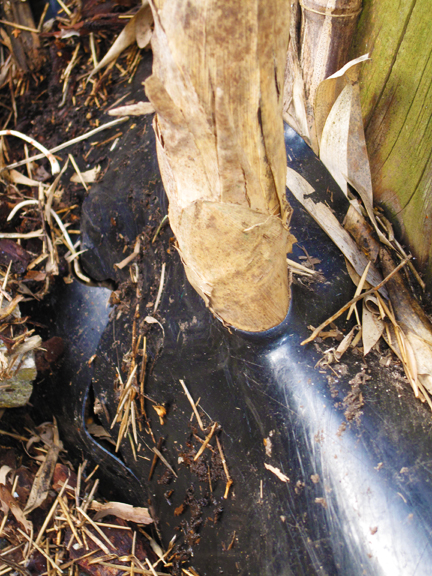
Emerging at the barrier's edge
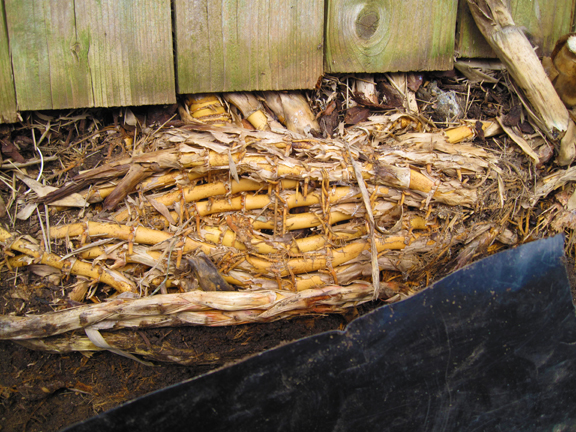
Rhizomes massed behind the barrier
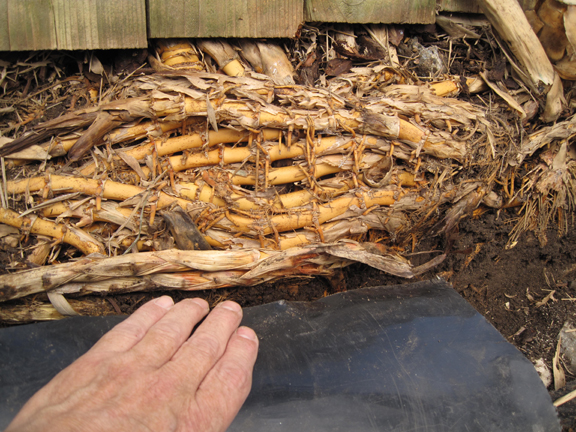
The full extent of what accumulated
Bamboo is a plant that conserves energy. Rhizomes travel away from the grove when the bamboo planting is not happy — kind of like teenagers who run away from home because their basic and expected needs are not met. Happy bamboo is not aggressive or invasive.
In the removal process Seattle Bamboo often encounters part of a grove that can be saved. This can only be discovered when digging underground.
Containing bamboo plantings is best accomplished by containers above ground. These plantings also become "rhizome bound" and removal and replacement is often suggested.
Transplanting
In the late fall, winter, and early spring bamboo can be successfully transplanted without undue transplant shock.
Water the bamboo deeply for a few days. Allow a few more days for the water to soak into the ground, the soil to become oxygenated, moist, and pliable. Dig out the root ball with as much rhizome as possible before transplanting. The root ball should not be packed hard with rhizomes and roots or the transplants will take years to recover.
Types of Bamboo
The difference is in growth habit. Clumping bamboo expands slowly outward with rhizomes staying close to the existing plant. These are called pachymorph rhizomes and cause new canes to be close to the original plant. Running bamboo spreads robustly via underground rhizomes and can travel yards away from the grove even before sending a cane above ground. The shoots are normally not at the end of the rhizome but in the middle, to provide stability.
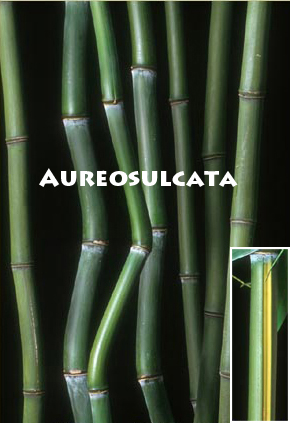
P. Aureosulcata
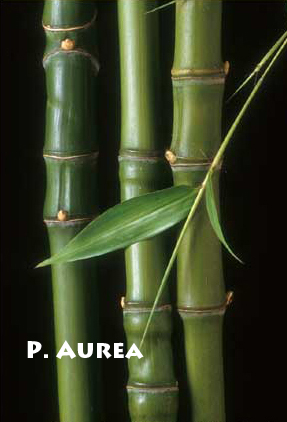
P. Aurea
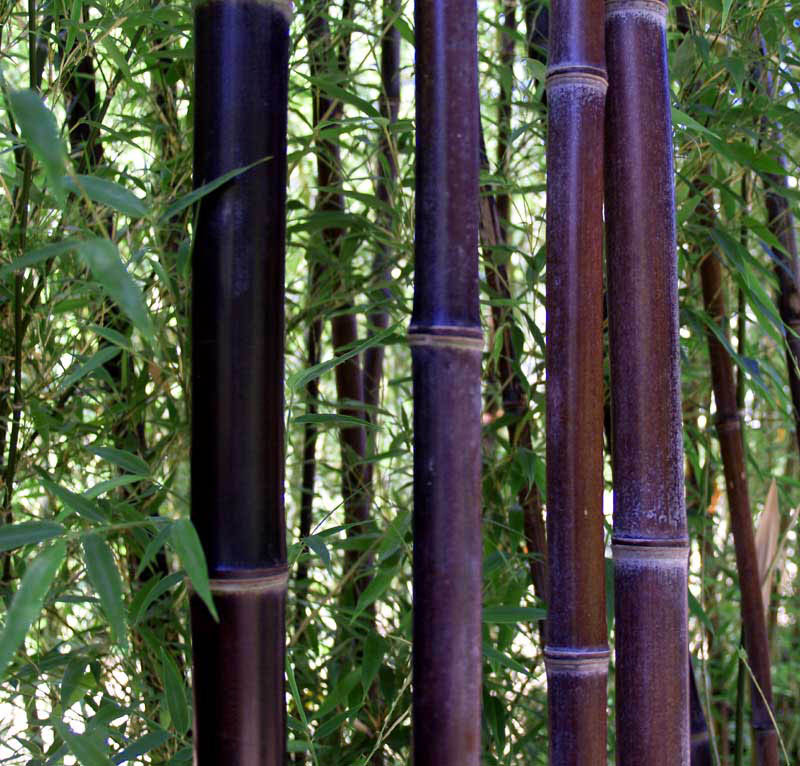
P. Nigra varieties
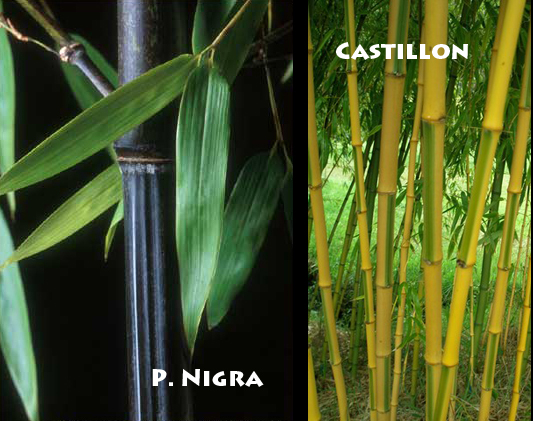
P. Nigra (left) and Castillon (right)
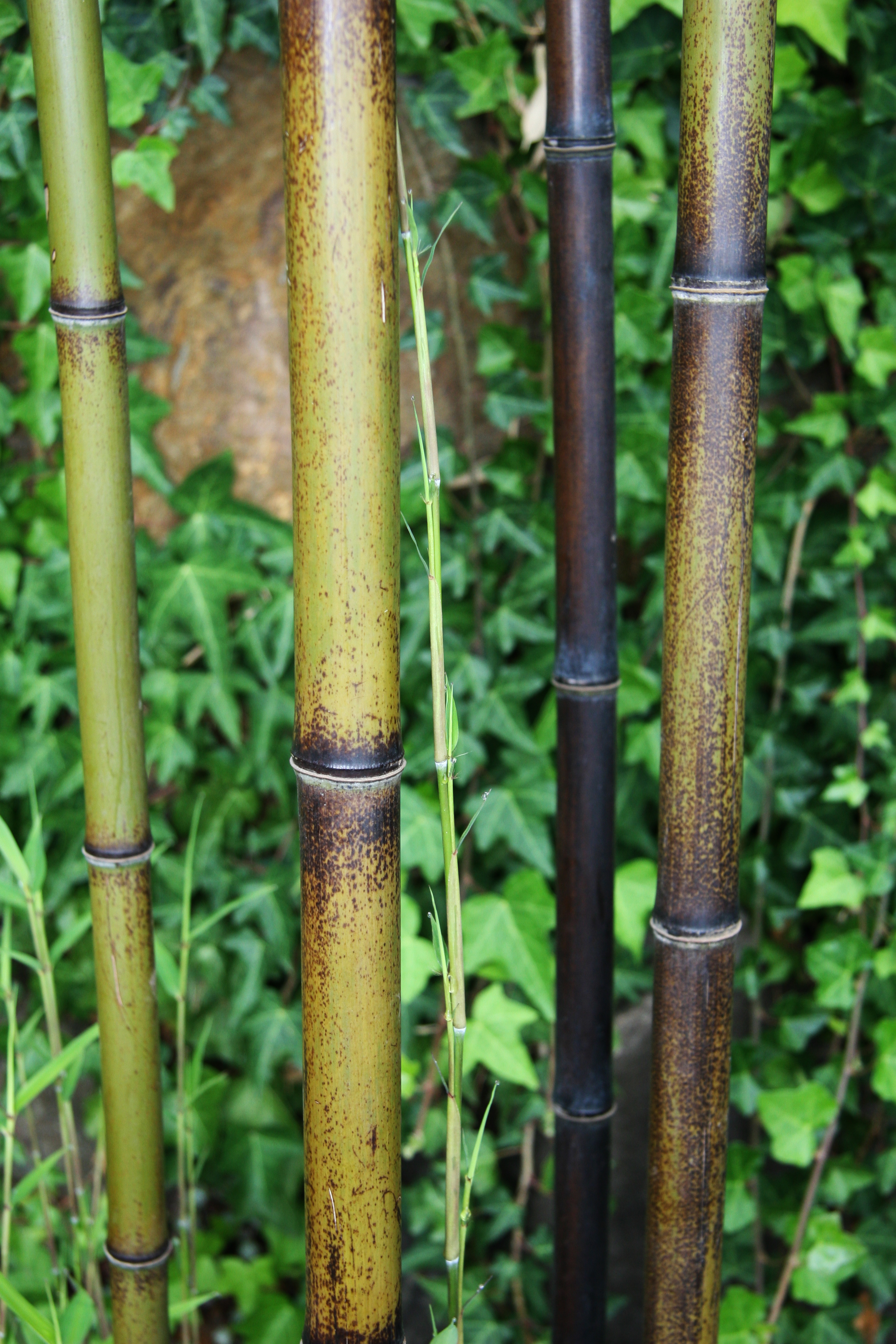
Striking color variation in some varieties
Not sure which type you have? Email us a photograph and we will identify it.
Fertilizing
Early spring and later fall. Only a small amount of fertilizer should be used to replace nitrogen in the soil.
Hiring Us
Yes. We ask you to submit images and measurements of the length and width of the grove as well as your name, address, and telephone number. Always leave a good contact number or specify times to call — we need to be able to contact you, preferably while we are preparing an estimate.
Often a site visit is required, but it is the owners of the company that visit, not estimators or employees. Their time is very valuable, especially during bamboo growing seasons from April to September.
Yes, and we post our contractor identification here on the website. Licensed WA State SEATTB*913ML. Insured to $3,000,000.
The owners of the company remove the bamboo. If we utilize employees we are always on site to supervise. We never leave laborers to work on your property.
Our service is premium and when we estimate costs there are no hidden fees and a firm guarantee is always included. Removal, hauling, appropriate disposal, and a guarantee are all part of our full service removals.
Yes. If we are contracted to remove bamboo in an area on your property and a sprout arises, we return to remove it as soon as we can. And that is forever.
Our estimates are based on measurements of the grove, depth of the rhizomes (because of overgrown barriers, prior removal attempts, ineffective watering, or lack of soil nutrients), variety of bamboo, and other factors. If you measure the grove, our estimates are based on those measurements.
Not blindly, no. Bamboo quotes are unusually hard to compare, because nearly everything that decides whether the work holds happens below the ground and then gets backfilled. Two bids can sit within a hundred dollars of one another and describe entirely different pieces of work — one removing rhizome from the soil, the other cutting through it and laying a barrier over the top.
So we would rather do something more useful. Send us the quotes you have received and we will review them at no charge and with no obligation — what they cover, what they leave out, and what we would ask the contractor who wrote them. If their approach is right for your situation, we will tell you so.
We have also set out the questions worth asking any bamboo contractor, ourselves included: What to ask before you hire anyone to remove bamboo →
We are not. We are a unique bamboo company because we do not think bamboo is a good choice for residential properties unless diligent maintenance is available by trained professionals. Bamboo societies by their nature encourage what we discourage. Besides, the owners — warriors in the groves — are not really "joiners." The point is that diligent maintenance is required if bamboo is planted on any size property less than ten acres.
Seattle Bamboo maintains groves throughout the greater Seattle area. If you are having bamboo planted or have a grove on your property, considering this service is a great idea.
Neighbor Issues
We will answer this question in far more detail based on your personal experience. But first:
- Contact the neighbor in writing — leave a note on their front door. Inform them that their bamboo rhizomes have shown up on your property as evidenced by the canes shooting in your garden or lawn. Help them understand that the problem may be far greater, as underground rhizomes often travel without producing above-ground growth. No one knows where the underground rhizomes are until excavation begins.
- Do NOT cut the shoots — they will lead you to the rhizomes without digging up your entire garden or lawn.
- Not cutting new shoots is the best advice, as the rhizomes do not travel farther afield until the shoots are mature and leafed out. The rhizome, luckily for us, cannot do two things at once.
- Dig out all rhizomes that can be located on your property.
- Then you may need a professional to advise what to do to avoid the return of the neighbor's bamboo to your property.
- If they are unresponsive you may need an attorney. In 20 years we have seen very few cases ever go to court, especially if you have expert advice in the form of a consult and report — which we provide your attorney for a fee.
We will answer this question in far more detail based on your personal experience. But first:
- If the neighbor has contacted you — you need to act to avoid attorney costs and additional problems.
There are so many variables that we prefer to consult with you about the history. Please call or email us.
We will answer this question in far more detail based on your personal experience.
The answer will be based on a number of factors including property levels, fence construction, concrete walls, rock walls, and other site-specific conditions. Please call or email us to discuss.
Don't see your question? Email bruce@seattlebamboo.com — we answer every question personally and add it here.
We also consult for free throughout the US and Europe.