Today’s field report concerns a grove of Semiarundinaria fastuosa ‘Viridis’ — often called Green Temple, or simply Temple bamboo.
It is not a nice plant to have in a residential garden. In fact, it is the worst nightmare to remove. I call it dragon bamboo: robust, fast, filling a dense screen quicker than most — and a monster to get rid of. And it always needs getting rid of, because when mature, this variety seeks acreage. A three-foot barrier does not stop it. A four-foot concrete wall does not stop it. It dives, and it seems perfectly content down there — it does not run shallow to breathe the way Phyllostachys will.
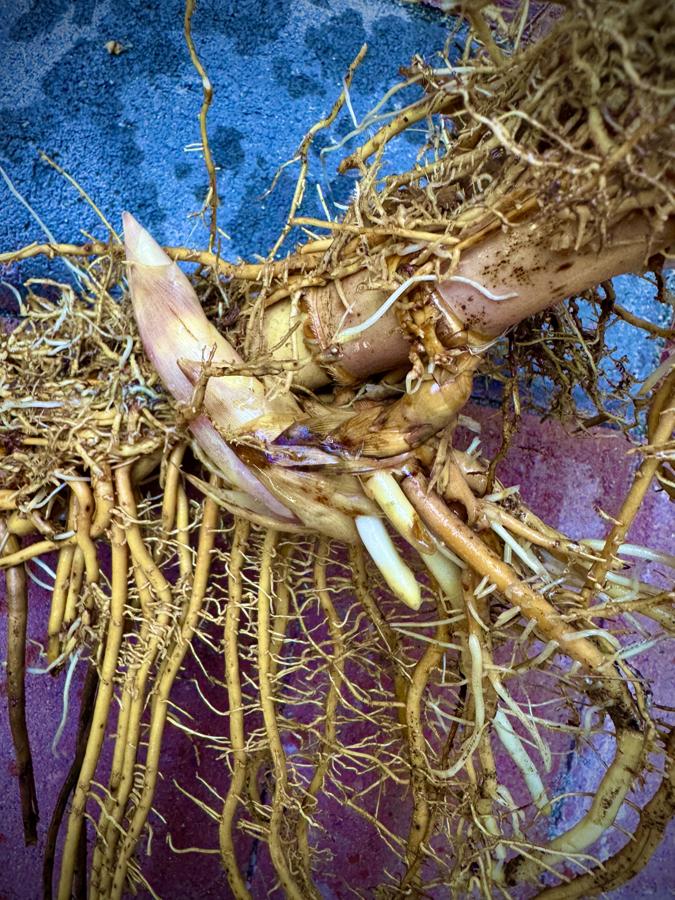
In the trench you can see the barriers. The first was doubled over on itself in the soil, wrapped back against its own face. Years ago that doubled-over barrier was judged to have failed, and a repair was made: a new third barrier was slipped cleverly between the folds of the original, extending its height and its depth.
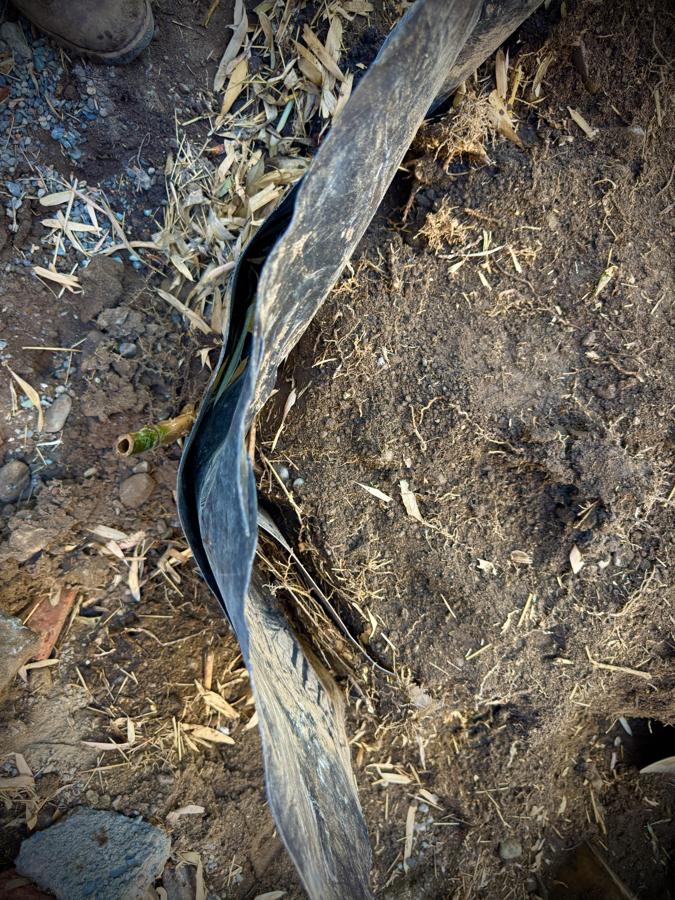
Here is the reveal, and the catch. The barrier had not failed as a wall. It failed at its laps.
Look again at the rhizome in the first image — the traveler. See how little soil clings to it. There was almost none where it grew. It did not breach the plastic, and it did not find a gap of earth to cross. It grew between the layers — in the thin, dark space where the original barrier doubled over itself, and where the third sheet was later slipped into the lap. Three layers of plastic did not make a wall. They made a burrow.
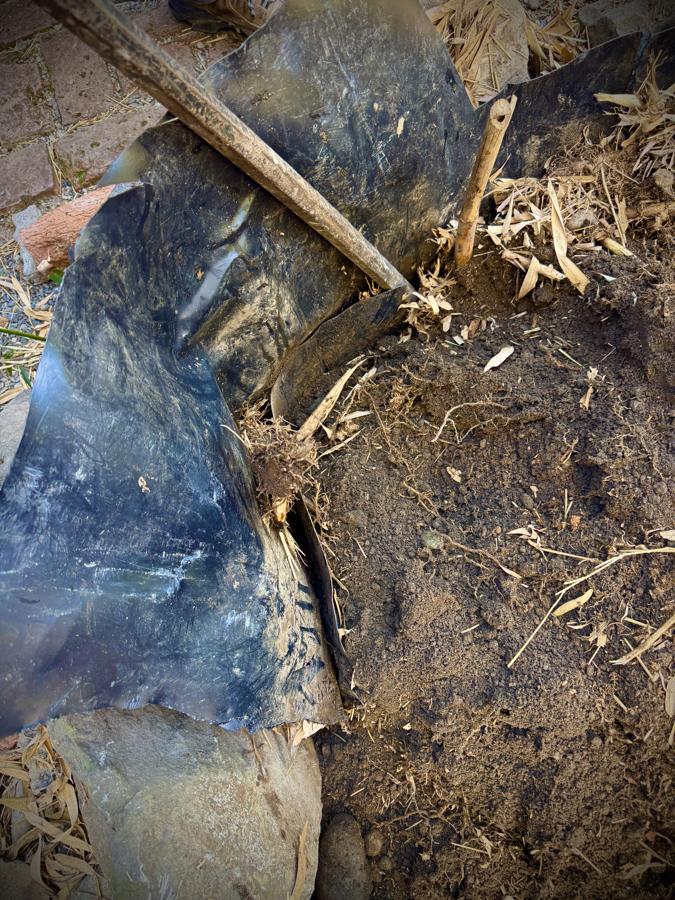
And a bamboo rhizome asks almost nothing to run. Not much soil. Not much room. Only darkness — which suits its dark little heart. The laps gave it exactly that: a lightless channel, running the length of the barrier, leading out into the garden. The wrap did not contain the rhizome. It housed it.
Which means the original inspection was wrong, and so was the plan built on it. The repair extended the barrier’s reach but reproduced its flaw: the third sheet, slotted into the double wrap, did not close the seam — it added another one. A barrier’s weakness is rarely the material. It is the join. And doubling a barrier over itself does not add protection. It manufactures a path.
For a deep-diver like this one, the lesson is plain enough. The enemy is not the height of the barrier, nor its depth — this one had both. It is the laps and folds. A barrier for a diver like this wants to be continuous, its unavoidable joints sealed tight enough to leave no dark hollow, because a hollow is all the plant is looking for.
We have been asked, “What would you do to stop this obvious escape route?” The answer is: we would not. Seattle Bamboo would not place a barrier around a bamboo grove at all. It is a lazy way to maintain.
Then we are asked, “What do you do to contain bamboo, if not with a plastic barrier?”
We call it confining — and we focus on maintenance rather than containment. But the 100% truth is that Seattle Bamboo does not want to, and rarely does, plant bamboo at all.
But that is another story — one that will relate to what we discover in the field.
We are not here to teach anyone anything — only to report what we find in the field. Or, in this case, in the grove.
All Rapports de Terrain →